How to Write a Painting Estimate: Steps & Example
Measure the walls, work out paint and labor, add overhead and profit, and put it in writing. A step-by-step painting estimate guide with a worked example and a free template.
Published · Updated · 7 min read

Quick answer
To write a painting estimate, measure the paintable area (wall perimeter × height, minus doors and windows), divide by your paint’s coverage to get gallons, add labor hours × your hourly cost, then add overhead and profit to reach the price. Put the scope, exclusions, price and an expiry date in writing before you send it.
Key takeaways
- Paintable wall area = 2 × (length + width) × height, minus doors and windows. A 14 × 11 ft room with 9 ft ceilings, one door and two windows has 399 sq ft of wall.
- Paint makers commonly rate a gallon at roughly 350 to 400 sq ft per coat. Multiply the area by the number of coats, divide by the rated coverage, and round up to whole gallons.
- A 20% markup is not a 20% margin. On a $539.00 cost, markup gives $646.80 and margin gives $673.75.
- On homes built before 1978, the EPA’s lead-safe rule can apply to painting. Check your certification before you price the job.
- Send the estimate with the scope, the exclusions, the price, how long it is valid and how to accept.
Step 1: Walk the job and ask the right questions
An estimate is only as good as what you learn at the walkthrough. Look at every surface that will be painted, note its condition, and ask the questions that change the price before you pick up the tape measure.
Walkthrough checklist
- Which rooms or surfaces are included, and which are not?
- Interior or exterior? Walls, ceilings, trim, doors, cabinets?
- Surface condition: peeling, cracks, stains, bare wood, glossy finish
- Prep needed: patching, sanding, caulking, priming, washing
- Is the space occupied? Furniture to move or protect?
- Colors, sheen and any specific product the client wants
- Access: ladders, scaffolding, tall ceilings, stairs
- Year the home was built (lead-safe rules apply before 1978)
- Timeline, working hours and parking
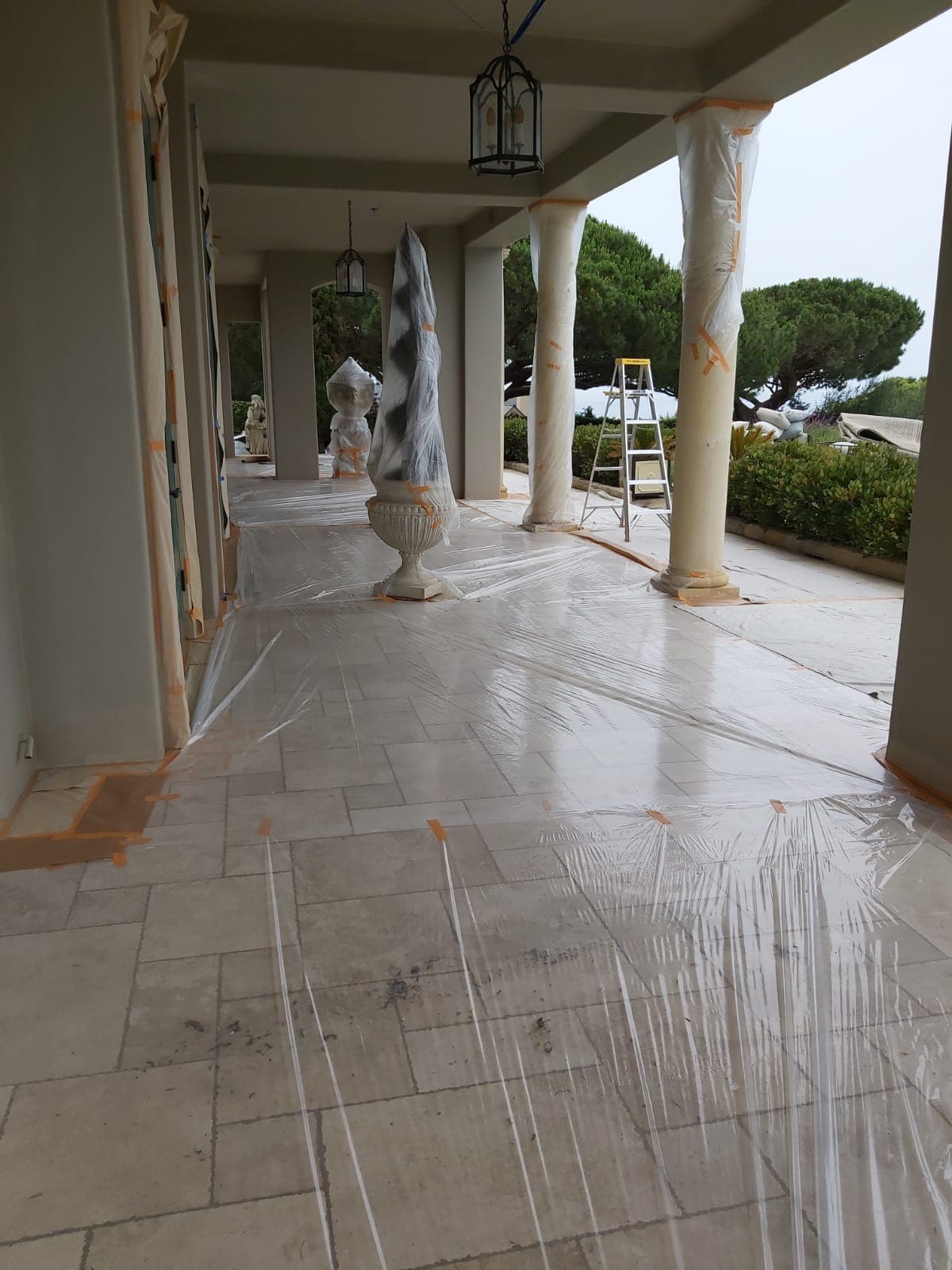
Take photos of what you see. They help you remember details when you price the job and give you a record of the condition before you started.
Step 2: Measure the space
For each room, measure length, width and ceiling height in feet. The walls are four rectangles, so total wall area is the perimeter multiplied by the height.
- Perimeter: 2 × (14 + 11) = 50 ft
- Gross wall area: 50 × 9 = 450 sq ft
- Openings: 1 door × 21 sq ft + 2 windows × 15 sq ft = 51 sq ft (a 3 × 7 ft door and 3 × 5 ft windows)
- Paintable wall area: 450 − 51 = 399 sq ft
Ceilings are length × width (14 × 11 = 154 sq ft). Price trim, doors, baseboards and cabinets as their own lines: they take more time per square foot than open wall, and lumping them in with walls hides the labor.
Standard door and window sizes are a convenient shortcut; measure the real openings when they are unusual. Whether you subtract small openings at all is your call, as long as you apply the same rule to every estimate.
Step 3: Turn area into gallons of paint
Paint makers commonly rate a gallon at about 350 to 400 square feet per coat (Sherwin-Williams). Check the data sheet for the exact product you plan to use, because rough, porous or heavily patched surfaces take more paint.
- Coverage area = paintable area × coats: 399 × 2 = 798 sq ft
- Gallons = coverage area ÷ coverage per gallon: 798 ÷ 350 = 2.28 gallons
- Round up to what you can buy: 3 gallons
Step 4: Price the labor
Labor is hours multiplied by your hourly cost. The reliable way to get the hours is your own history: time a few jobs, divide the area by the hours, and use that rate for similar work. Include prep, protecting floors and furniture, cutting in, every coat, and cleanup.
In the example, one painter spends eight hours on the room at a labor cost of $40 an hour: 8 × $40 = $320. Those rates are illustrations, not market prices. Use what the work actually costs you, including payroll costs and insurance if you have a crew.
Step 5: Add overhead and profit
Materials and labor are your direct costs. Overhead covers what keeps the business running: vehicle, insurance, tools, software and office time. One way to carry it is as a percentage of direct cost. Profit goes on top.
Worked example
Interior repaint of one room
- Paintable wall area
- 399 sq ft
- Paint: 798 ÷ 350 = 2.28, so 3 gallons × $40
- $120.00
- Supplies: tape, plastic, caulk, rollers
- $50.00
- Labor: 8 hours × $40
- $320.00
- Direct cost
- $490.00
- Overhead at 10% of direct cost
- $49.00
- Cost before profit
- $539.00
- Price with a 20% margin ($539.00 ÷ 0.80)
- $673.75
Illustrative numbers only. Replace every rate with your own. The free calculator runs these steps for you.
Margin vs. markup: why the same 20% gives two prices
Markup is a percentage added to your cost. Margin is the share of the price you keep. They sound alike and they are not: a 20% markup on $539.00 gives $646.80, and your profit is only about 16.7% of that price. To keep 20% of the price, divide your cost by 0.80 instead, which gives $673.75.
Neither is wrong, but pick one on purpose and use it on every estimate. If your goal is a target share of each sale, price on margin.
Step 6: Write the estimate
Now turn the numbers into a document the client can understand. Describe the work in plain language, area by area, instead of showing your cost build-up.
What to put on a painting estimate
- Your business name, contact details and license number where required
- Client name and the address of the job
- Estimate number, date and expiry date
- Scope by area or surface, including prep
- Paint products, sheen and number of coats
- Exclusions and assumptions
- Price, taxes if they apply, and payment terms
- Expected start and finish, or what determines them
- How the client accepts
The words estimate, proposal and quote are used loosely. If you are unsure which to send, read estimate vs. proposal vs. quote.
Check lead-safe rules on older homes
In the United States, the EPA’s Renovation, Repair and Painting rule requires firms that are paid to disturb painted surfaces in housing built before 1978 to be certified, and their employees to be trained in lead-safe work practices (EPA). That includes painters and sole proprietors. Ask the year the home was built at the walkthrough, and either price in the extra containment and cleanup or decline the job if you are not certified. State and local rules may add requirements.
Step 7: Send it and follow up
Send the estimate while the walkthrough is fresh. Say when you will follow up, then do it. In Estiggle you write the proposal against the client, email the customer a link to review and sign it, and turn the accepted work into an invoice without retyping anything. How to create and send a proposal in Estiggle shows each step.
Frequently asked questions
How do you calculate square footage for a painting estimate?
Multiply the room’s perimeter by its height to get gross wall area, then subtract doors and windows. For a 14 × 11 ft room with 9 ft ceilings that is 2 × (14 + 11) × 9 = 450 sq ft, minus 51 sq ft of openings, which leaves 399 sq ft. Add ceilings separately as length × width.
How much paint do I need to paint a room?
Divide the area to be painted, times the number of coats, by the paint’s coverage per gallon. Paint makers commonly rate coverage at about 350 to 400 sq ft per gallon, so 399 sq ft with two coats needs about 2.3 gallons, which rounds up to 3. Check the data sheet for your product.
Should I price painting by the square foot or by the hour?
Either can work if it comes from your own numbers. A per-square-foot rate is quick to quote, but derive it from the hours and costs of past jobs and check it against a bottom-up estimate like the one above. It is a sanity check, not a substitute for knowing your labor and materials.
How much profit should a painter add to an estimate?
There is no universal figure. Set profit from your overhead, your goals and what your market will bear, then apply it consistently as margin or markup. The calculator shows how a given percentage changes the price.
Do painters need lead-safe certification?
If you are paid to disturb painted surfaces in housing or child-occupied facilities built before 1978, the EPA’s RRP rule requires your firm to be certified and your workers trained. See the EPA’s program page for the current requirements.
How long should a painting estimate be valid?
Put an expiry date on it, because material and labor costs change. Choose a window that matches how long your own prices hold, and state it on the estimate.